7 Day Minimalist Planner KDP Template Explained
What This Planner Template Actually Offers
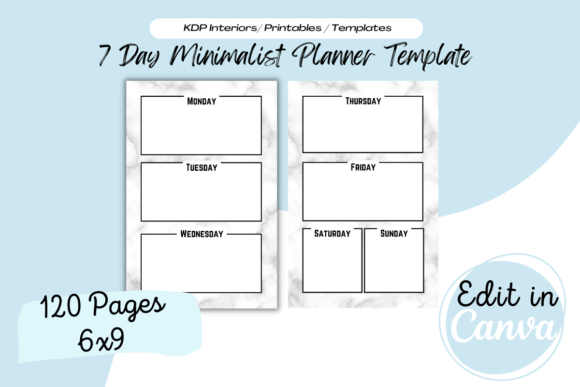
At its core, the 7 Day Minimalist Planner KDP Template is a ready-made interior file built for self-publishers. It gives you a clean, 6×9 inch layout spread across 120 pages, delivered as a Canva template. You open it, make the edits you want, and export a print-ready PDF. It skips the most time-consuming part of creating a weekly planner from zero: structuring every page, setting margins, balancing white space, and making sure Monday through Sunday feel coherent without overcrowding.
Because it lives inside Canva, there is no software barrier. You do not need InDesign, Affinity Publisher, or any deep design experience. The product was built, as the description puts it, to "make your KDP Journey a little easier. Save time when uploading your books. Reuse as many times as you want." That last sentence matters more than many newcomers realize. It means one purchase can fuel multiple planner variations, seasonal updates, or entirely different low-content books down the line.
Why Different People Care About the Same Minimalist Layout
A 7-day planner sounds straightforward, but the reasons someone reaches for a pre-made template vary wildly. For a first-time KDP publisher, the draw is usually fear reduction. They have read about bleed settings, ISBN requirements, and interior formatting, and they want something that eliminates self-doubt. For a marketer or small business owner, speed is the main currency. They may need a lead magnet, a client gift, or a branded item quickly, and waiting a week for a custom design slows everything else.
An educator or coach might see the template as a way to produce structured reflection sheets for students or clients, without turning the task into a design project. A hobbyist or someone exploring creative side income may care most about the low-pressure entry point — a chance to try publishing without investing heavily in tools or labor. Across all these groups, the template appeals not because it shouts creativity, but because it stays quiet enough to let the user’s own purpose take the lead.
Design That Adapts to Your Workflow, Not the Other Way Around
One of the biggest friction points in low-content publishing is fighting the file. You buy a template, then spend hours removing elements you never wanted. The 7 Day Minimalist Planner KDP Template reduces that friction by being intentionally underdone. It gives you the skeleton: 120 pages with a consistent weekly rhythm, ample negative space, and no decorative clutter you have to peel away. From there, you add your color palette, font choices, logo, or subtle section headers — or you leave it exactly as is, knowing the clean aesthetic already appeals to buyers who find busy planners overwhelming.
Because you edit in Canva, the template respects different comfort levels. A graphic designer can layer in custom icons and adjust every element freely, while a blogger or freelancer with limited design chops can simply change the text and upload. Both workflows produce a professional result. That flexibility is what turns a static 120-page file into a long-term tool you return to whenever you need a new planner variant.
Practical Example: The Launch-First Mindset
Imagine someone who wants to publish their first KDP planner this weekend. They have no established audience and no design background. They open the template, adjust the header text to "My Calm Week," add a soft sage green accent, and export. By Sunday evening, their book is in review. The template absorbed the technical heavy lifting, so all their energy went into the small, personal touches that make a product feel like theirs.
Practical Example: The Efficiency-Obsessed Creator
Now picture a seasoned KDP seller who already has several lined journals in their catalog. They use the template not because they cannot design from scratch, but because doing so for every new idea means lost weekends. They duplicate the template, rearrange the daily block into a horizontal layout, swap fonts, and create a fresh planner in an afternoon. The reusable nature of the template directly feeds their ability to release consistently without burnout.
What First-Timers Should Look For in a Template
If you are new to KDP, your checklist probably sounds like this: Will this actually print correctly? Do I need to understand bleed? How many pages should I have? The 6×9 trim size is one of the most forgiving dimensions for Amazon KDP, which eliminates common sizing headaches. The 120-page count gives enough room for a substantial weekly section without bloating the file or creating an awkwardly thin spine. For beginners, these pre-resolved decisions matter enormously because they prevent the “rejected manuscript” email that can stall momentum for days.
The template also sidesteps a mistake many newcomers make: overcomplicating the interior. Minimalism here is not just an aesthetic, it is a functional safety net. A simple layout reduces the chance that heavy graphics cause printing errors, increase file size excessively, or look muddy in black and white. You can still add your personality, but the underlying structure stays reliable.
For Those Who Value Long-Term Usefulness Over One-Time Speed
Some buyers evaluate a template on immediate time savings alone. Others, particularly entrepreneurs and publishers, think about asset lifespan. The 7 Day Minimalist Planner KDP Template is not tied to a specific year, month, or theme. There are no dated pages, no seasonal illustrations you will need to strip out next quarter. That deliberate neutrality means you can publish a 2025 edition, a 2026 edition, or an undated version with minimal rework. For a small business building a catalog, that kind of reuse directly lowers cost per product over time.
Additionally, a template that lives in Canva stays editable as Canva evolves. You are not locked into a version of software that might become obsolete. As the platform adds features, your template gains them too. That future-proofing might not matter on day one, but six months in, when you want to add a new page style or adjust spacing, it becomes surprisingly valuable.
What "Reuse as Many Times as You Want" Truly Means
This license point deserves clarity because similar-sounding offers often come with restrictions. The ability to reuse the template without additional fees or seat limits means a freelance designer can use it for client projects, or an educator can create customized planners for multiple course cohorts. A creator running a small Etsy or KDP shop can build a whole series — Weekly Focus Planner, Simple Habit Tracker, Minimalist Meal Plan — all from the same base file. The only real cost is the time you invest to remix the layout.
Balancing Creativity With Practical Constraints
There is a quiet tension all self-publishers face: they want their product to stand out, but they also need to ship. A minimalist template helps navigate that tension by giving you guardrails. The structure is already tested: 7 days, clear sections, readable proportions. Your creativity goes into what makes the product yours — the cover, the introductory pages, the color accents, or the bonus pages you add before or after the weekly spreads. This separation of roles keeps the project moving without letting perfectionism stall it indefinitely.
For example, a wellness coach might add two pages at the front for setting weekly intentions and two at the back for Sunday reflections. A busy professional using the template for personal time management might add a small task list column to each day. Neither change breaks the core layout, because the template’s simplicity makes it resilient to additions. Editing becomes additive, not combative.
Identifying Whether This Template Matches Your Project
The right template matches your current ability level, your typical content type, and how you want to present yourself to readers. Ask yourself a few practical questions:
- Do I want a planner that feels airy and calm, rather than densely packed? The minimalist aesthetic attracts buyers seeking clarity, and the template delivers that naturally.
- Do I need a printed book, or am I creating a digital download? The 6×9 size works beautifully in print; for digital use, you can export from Canva as PDF and retain crisp legibility on screens.
- How comfortable am I learning new software? If the idea of building a 120-page doc from scratch makes you anxious, a Canva template removes the technical fear and lets you start editing today.
- Will I release more than one planner this year? If yes, the reuse capability becomes a genuine financial and creative advantage, not just a nice extra.
If you answer yes to most of these, the 7 Day Minimalist Planner KDP Template likely fits. It is especially strong for those who value ease of use, flexibility, and long-term usefulness over intricate, one-of-a-kind designs. And because the starting point is intentionally spare, your own taste and brand voice can still shine through without being buried in someone else’s decorative choices.
Making the Most of the 120-Page Format
One overlooked aspect is how the 120-page length shapes your final book. Too few pages can make a planner feel insubstantial; too many can feel overwhelming or push the printing cost higher than buyers want to pay. At 120 pages, the planner has enough space for a full 52-week year if you keep the layout undated and allocate roughly two pages per week, plus a handful of note or reflection pages. You can also use it as a quarterly or half-year planner and include more robust goal-setting sections.
When you edit in Canva, pay attention to what page 1 and page 120 look like, because they form the first and last impressions for the reader. A simple title page at the front and a blank notes page at the end, both pulled together in minutes using the template’s existing font styles, can give the whole book a polished, intentional feel without heavy design work.
How Educators and Coaches Might Remix the Template
Consider a teacher designing a weekly reflection journal for students. They do not want a commercial look; they want quiet, functional space for writing prompts. Using the template, they can delete the days of the week and replace them with "What I Learned," "Challenges Faced," "Gratitude," and "Next Week's Goal." The underlying 6×9 layout stays intact, and because the template is reusable, they can create separate versions for different grade levels or different terms without starting over each time. This kind of deep customization, built on a solid base, is where the template truly proves its worth beyond a simple planner.
Moving From Hesitation to Publishing Confidence
Many potential KDP creators delay publishing because they equate quality with complexity. The 7 Day Minimalist Planner KDP Template quietly challenges that belief. It shows that quality can also come from restraint, consistency, and a genuine understanding of what the end user needs — a simple, dependable structure to plan their week. The template handles the invisible architecture so you can focus on the visible decisions that express your voice. Whether you are a beginner aiming for your first upload, a freelancer juggling multiple client projects, or a seasoned publisher expanding a catalog, this planner template does not demand you become a designer. It just asks you to show up, make it yours, and publish. That shift, more than any feature list, is what changes a daunting KDP journey into a manageable, repeatable process.