Why a Password Logbook Premium KDP Interior Can Save Your Digital Life
In an age where forgetting a single password can lock you out of your bank, email, or entire business workflow, the old sticky note on the monitor is a recipe for disaster. Yet, relying solely on digital password managers can feel vulnerable to breaches or tech failures. This is where a physical record comes into its own, and a professionally designed Password Logbook Premium KDP Interior offers a structured, reliable solution. It’s not just a blank notebook; it’s a print-ready template specifically crafted for the Amazon KDP (Kindle Direct Publishing) platform, allowing creators to produce and sell a tangible tool for digital organization.
The Appeal and Practicality of a Physical Password Logbook
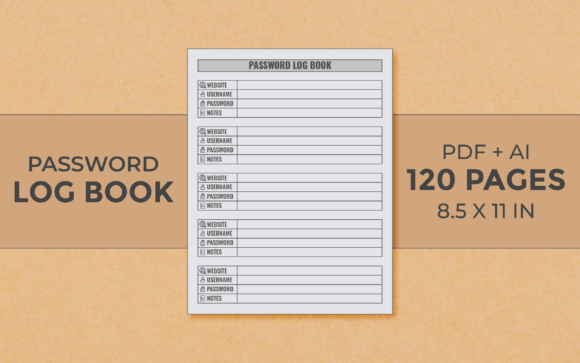
People are drawn to a physical password logbook for its simplicity and absolute offline security. It cannot be hacked from across the internet. For adults juggling numerous accounts—from social media for marketing to client portals for freelancing—having a central, organized reference is a productivity lifeline. The Password Logbook Premium KDP Interior transforms this need into a ready-to-use product. With its 120 pages, 8.5×11 inch trim size, and high-quality 300 DPI PDF, it ensures the final printed book will be clear, spacious, and professional.
Common Missteps When Choosing or Using a Password Logbook Template
Even with a great template like this, users and creators can stumble. Awareness of these pitfalls turns a good tool into an effectively used one.
Overlooking the Importance of Editable Source Files
A significant advantage of this interior is the inclusion of editable original AI files. A common mistake is to focus only on the final PDF and ignore these source files. The AI (Adobe Illustrator) format allows for customization—you can change fonts, adjust layout colors to match your brand, or add a logo before publishing. If you skip this, you’re stuck with the default design. This limits your ability to differentiate your product on KDP or tailor it for a specific niche audience, such as educators or small business owners.
Better Approach: Before you upload the PDF to KDP, open the AI files in a vector graphics program. Even simple changes, like altering the header color from blue to a calm green, can make your logbook feel unique. This customization step is what transforms a generic template into your own product.
Misunderstanding the “Print-Ready” Specification
The term “print-ready” can be misinterpreted. Some assume it means they can simply print the PDF at home on any printer. While you can do that, the template is optimized for commercial printing via KDP. The 8.5×11 inch trim size and 300 DPI resolution are industry standards for a crisp, bound paperback. A mistake is using a low-resolution or incorrectly sized version for KDP, which results in blurry text or rejected uploads.
Practical Advice: Always use the provided Print PDF file for KDP upload. Do not resize it or convert it to a different DPI. The included PNG files with transparent backgrounds are typically for promotional use—like creating mockup images for your KDP listing—not for the interior itself. Keeping these assets separate ensures final print quality.
Underestimating the Need for Offline Backup
For the end-user buying the printed logbook, a major oversight is treating it as the sole record. A physical book can be lost or damaged. The corrective advice isn’t to avoid using it, but to integrate it into a broader system.
Realistic Example: A blogger might use the Password Logbook Premium KDP Interior to diligently write down all their platform passwords. The better approach is to periodically take a high-quality photo or scan of the filled pages and store that encrypted file on a separate, secure drive. This creates a digital backup of your offline record, merging both security philosophies. The logbook is your primary, daily tool; the scan is your disaster recovery plan.
What to Evaluate Before Publishing or Purchasing
Whether you’re a creator looking to publish on KDP or a consumer looking to buy such a logbook, a few checks will guide a better decision.
For Creators on KDP
Examine the interior layout thoroughly. Does it have sufficient fields for the information you need? Standard templates include website, username, password, and notes. Check if the 120-page count aligns with your market expectation—it offers ample space without being bulky. Crucially, verify that the file package is complete: the Print PDF, the editable AI files, and the PNGs. A missing component limits your flexibility. Also, consider your audience: the clean design of this interior suits professionals and beginners alike, but you might use the AI files to add a subtitle like “For Freelancers & Entrepreneurs” on the cover mockup.
For Consumers Buying a Printed Logbook
When you see a password logbook on Amazon, look beyond the cover. Check the product description for details like page size and layout. An 8.5×11 inch book offers large, readable boxes, which is far more usable than a cramped pocket-sized version. Ensure it mentions a structured, consistent format for entries—chaotic, uneven pages lead to messy records. Look for hints that the publisher used a professional interior template; this often indicates better organization and print clarity. Finally, decide on its place in your workflow: will it sit on your desk for daily use, or in a locked drawer for weekly reference? Positioning it correctly from the start prevents it from becoming an out-of-sight, out-of-mind clutter item.
Integrating the Logbook into a Healthy Digital Hygiene Routine
The ultimate value of a tool like the Password Logbook Premium KDP Interior is not just in owning it, but in how it’s used. A common final mistake is using it inconsistently—jotting down a new password but skipping the “notes” field where you store recovery questions or associated email addresses. This halves its utility.
Make a simple rule: every new account creation or password change session ends with a complete entry in the logbook. Use the notes column to add dates, hints for complex passwords, or linked account information. This turns the book into a true master reference. For the entrepreneur or marketer managing multiple client accounts, this discipline saves hours of frustrated recovery attempts and maintains seamless business communication.
By choosing a well-designed template, understanding its components, and employing it with a backup strategy, this physical logbook becomes a cornerstone of practical, secure digital life management. It bridges the gap between the fear of digital memory and the chaos of paper, providing a controlled, reliable anchor for your online identity.