Integrating the Daily Affirmations Journal into Your Creative Publishing Process
For entrepreneurs and creators building a business around self-publishing, particularly on platforms like Amazon KDP, the workflow is paramount. Efficiency, scalability, and consistent quality are the pillars that transform a hobby into a viable income stream. Within this structured process, a product like the Daily Affirmations Journal represents more than just a digital file; it is a versatile asset designed for seamless integration into your publishing pipeline. Understanding where it fits and how to leverage its features can significantly streamline your operations and enhance your product offerings.
A Core Asset in the Low-Content Book Niche
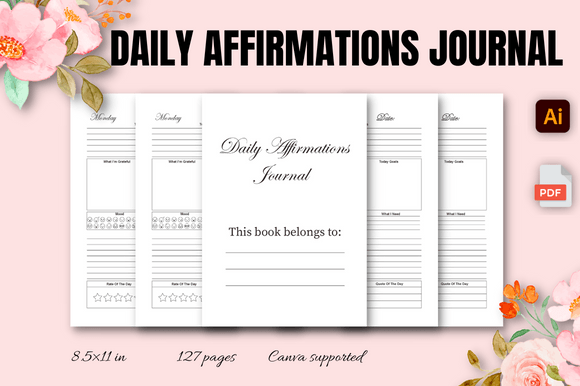
The Daily Affirmations Journal is a professionally designed, ready-to-use template specifically crafted for the low-content and no-content book market. This niche thrives on providing structured frameworks—like journals, planners, and diaries—that users can personalize. This journal is a complete package: a 127-page interior file formatted for standard US letter size (8.5” x 11”), created without bleed for straightforward home or professional printing. Its primary value lies not just in its content, which centers on daily affirmations for positivity and goal-setting, but in its technical design for adaptability.
Where it fits into your broader publishing process is at the asset preparation stage. After market research and niche selection, you need reliable, high-quality interior files. This journal eliminates the need for original graphic design or complex layout work for this specific product type. Instead, you acquire a foundational template that is fully editable in Adobe Illustrator and provided as a high-resolution, vector-based PDF. This means every element—text, lines, shapes—is mathematically defined, allowing for infinite resizing without any loss of clarity or quality. You can adapt the journal to various book dimensions (e.g., 6” x 9” for a more traditional paperback) with minimal effort, ensuring compatibility across different KDP trim size options.
Technical Integration and Workflow Enhancement
The practical integration of the Daily Affirmations Journal into your KDP workflow involves a few key steps that capitalize on its features. Upon acquisition, you receive the AI (Adobe Illustrator) source file and the print-ready 300 DPI PDF. This dual-file approach supports two distinct workflow paths.
For the fastest route to publication, the provided PDF is already optimized. You can upload it directly to KDP as your book’s interior file, pair it with a cover design, and proceed to publishing. This is ideal for testing the market or launching a product quickly. The no bleed specification simplifies this, as KDP’s requirements for bleed are only necessary for full-color books where design elements reach the edge of the page; for this journal, the margins are safe and clear.
The more powerful workflow, however, utilizes the editable Illustrator file. This is where you move beyond a single product to create a suite. Perhaps your research indicates a demand for a smaller, pocket-sized affirmation journal or a larger workbook format. Because the design is vector-based, you can change the document size in Illustrator effortlessly. All elements scale perfectly. You can then modify colors, alter affirmation prompts, or even translate text for different markets, maintaining a consistent, professional aesthetic across all variations. This turns one purchase into a source for multiple unique KDP listings, dramatically improving your operational efficiency and product portfolio consistency.
Preparing for Production and Quality Control
Long-term success in no-content publishing hinges on quality control. A poorly formatted PDF can lead to customer complaints and negative reviews. The Daily Affirmations Journal, being a print-ready file built to industry standards, mitigates this risk. The 300 DPI resolution ensures text and graphics are sharp when printed. Before uploading, your preparation step is simplified: a quick review to confirm your chosen trim size matches the PDF dimensions. If you’ve resized the vector file, a crucial tip is to regenerate the PDF at high resolution from Illustrator, ensuring the DPI remains intact. This attention to technical detail in your workflow prevents post-publishing issues.
Furthermore, its structure as a classic notebook or diary—with dated pages, sections for written reflections, and thematic prompts—means it interacts seamlessly with your customer’s use case. They don’t need additional tools; the journal itself is the tool. For you, the publisher, this translates to a product with clear utility and high perceived value, which supports positive rankings and repeat business models, such as creating sequels or themed variations (e.g., an affirmation journal for professionals, students, or new parents).
Strategic Use in a Broader Creative Business
For the entrepreneur, this journal can serve multiple roles beyond a single KDP listing. Consider a blogger or educator who creates content around mindfulness or personal development. They can use the editable file to produce a custom journal as a lead magnet or a paid product for their own website, leveraging the same core asset. A freelancer offering design services could use the vector file as a starting point for a client’s branded journal project, saving hours of initial layout work.
The integration also touches on organization and branding. If you are building a store around “unique designs,” as the prompt suggests, this journal becomes a cornerstone product. You can ensure all your journal products maintain a cohesive design language by using this template as your foundation. This consistency aids in brand recognition and customer trust. The process here involves not just publishing, but catalog management: creating a family of products derived from one reliable source, making inventory and marketing efforts more focused.
Practical Implementation for Scaling
To truly integrate this asset into a scaling business, adopt a methodical approach. First, use the provided PDF for a swift launch. Gather market feedback. Then, utilize the Illustrator file to iterate: create a version for a different audience, a seasonal edition, or a complementary product like a companion coloring page (linking to the suggested store strategy). This iterative process, fueled by a flexible template, allows for data-driven growth. You’re not constantly searching for new designs; you’re adapting a proven one.
Another practical observation is file management. Keep the original AI file and all your derived versions organized in a dedicated project folder. Label them clearly (e.g., “Affirmation Journal – Original,” “Affirmation Journal – 6x9 Student Edition”). This organizational habit within your publishing workflow ensures you can quickly revisit, update, or repurpose designs months or years later, supporting long-term use of the asset.
Conclusion: A Tool for Efficient Publishing
Ultimately, the Daily Affirmations Journal is a workflow tool. It fits into the preparation and production phases of your KDP business, reducing the time and skill barrier required to create a professional-grade product. Its vector-based, editable nature provides the flexibility needed to adapt to market trends and customer preferences without starting from scratch. By understanding its role as a scalable template, you can integrate it smoothly into your routine: launch quickly, iterate based on performance, and build a consistent product line. This turns the act of publishing from a series of discrete, labor-intensive projects into a more streamlined, efficient process where your energy is focused on marketing, strategy, and growth, rather than repetitive design tasks. For the productivity-minded publisher, it’s an asset that supports not just a single sale, but a sustainable publishing system.